 Clarity Rooms
The quickest way to organise your life when there is too much going on is to stop keeping it in one place. Split it into the few areas it really falls into, give each area its own short list of next steps, and keep one separate view of anything with a date. Then, each day, pick one area and give it your full attention.
That sounds obvious written down. It took me a long time to actually do it.
What my list looked like
I had my work, a business, a rental property, house jobs, tax, and everything in between. All of it lived in one long list. Client work sat next to a repair at home, next to a filing deadline, next to booking a flight.
The list was complete. It just never told me where my head actually was. I could not see that the house jobs had quietly piled up while I was busy with the business, or that one area had nothing urgent and could wait a week.
Why the small jobs always end up at the bottom
Like most people, I prioritise. What is most urgent, what is most important, what is the 80/20 thing that covers off the most. That works for the big things. The problem is everything else.
The small, shallower tasks are low importance, so they naturally sink to the bottom of the pile and quietly build up. Nobody decides to ignore them. They just never win.
Tax is the classic example. In the UK, Self Assessment is due at the end of January, and so many of us leave it to the last minute. Part of the reason is simply that it is boring, and there is always something more pressing going on in life. So we do it when we absolutely have to.
From Jonathan: There are a bunch of us who are just like that, and that is okay. I am one of them. Leaving things to the last minute is often how we work best.
Where it goes wrong is when a genuinely urgent, important job lands at the same time as all the small things you have left to the last minute. Now you have to do more in the same amount of time, and that is where the pressure comes from.
I do not think the answer is to change how we work. It is to get clarity: what there is to do, when each thing is due, and how often it comes round. Every first of the month, every January, every renewal. Then nothing creeps up on you, even if you still choose to do it late.
We overestimate how long boring jobs take
The other thing I have noticed is that we often leave things because we overestimate how boring and how long they will be. "That is going to take me two full days." In reality, if you had noted it down last time, it might take half a day, or a few hours.
Most of that time goes on remembering. It has been six months or a year since you last did it, so you have to work out again how you did it and where everything was. That is where a short note to your future self, and a link to where things live, saves hours.
Step 1: name the areas of your life
Start by writing down the four to six areas your life actually splits into right now. Not the ideal ones, the real ones. Mine are work, the business, home, money and health.
A few things help:
- Keep it to six at most. More than that and you are back to one long list with headings.
- Name them the way you think about them. "House jobs" means more to me than "Category 3".
- It is fine for one area to be quiet. Seeing that it is quiet is useful too.
Step 2: give each area its own next steps
Each area gets its own list, and only the next few steps go on it. Not every idea, not the whole project, just what you would do next if you sat down with it today.
Bigger jobs get broken into steps, and some steps have to come first. You cannot book the boiler engineer before you know when someone can be in, so that step waits until the first one is done.
For anything that comes round again, like a monthly task or an annual return, set it to repeat and leave yourself a note: roughly how long it took, and a link to where you found everything. Next time it is a few hours, not a weekend of remembering.
Step 3: keep dates in one separate view
The one thing that does need to be in one place is anything with a date. Tax deadlines, renewals, a gas safety check, a client report due on Friday.
So alongside the areas, keep one view that pulls together everything with a date, from every area, soonest first. Check that first. Then you can stop worrying that something is slipping while you focus on one area.
Step 4: walk into one area at a time
This is the part that changed things for me. Each day I look at everything due, then pick one area and only look at that. Everything else stays outside the door until I am done.
What my mornings look like
The first place I go is the hall, or the lobby as I sometimes call it. There is a board there that gives me the overview: what is at the top of the list across everything.
It is at the top because of decisions I made earlier. When I was in a room and a task came to mind, I added it there and set a date if there was a deadline. So the morning overview is really my past self telling me what matters today.
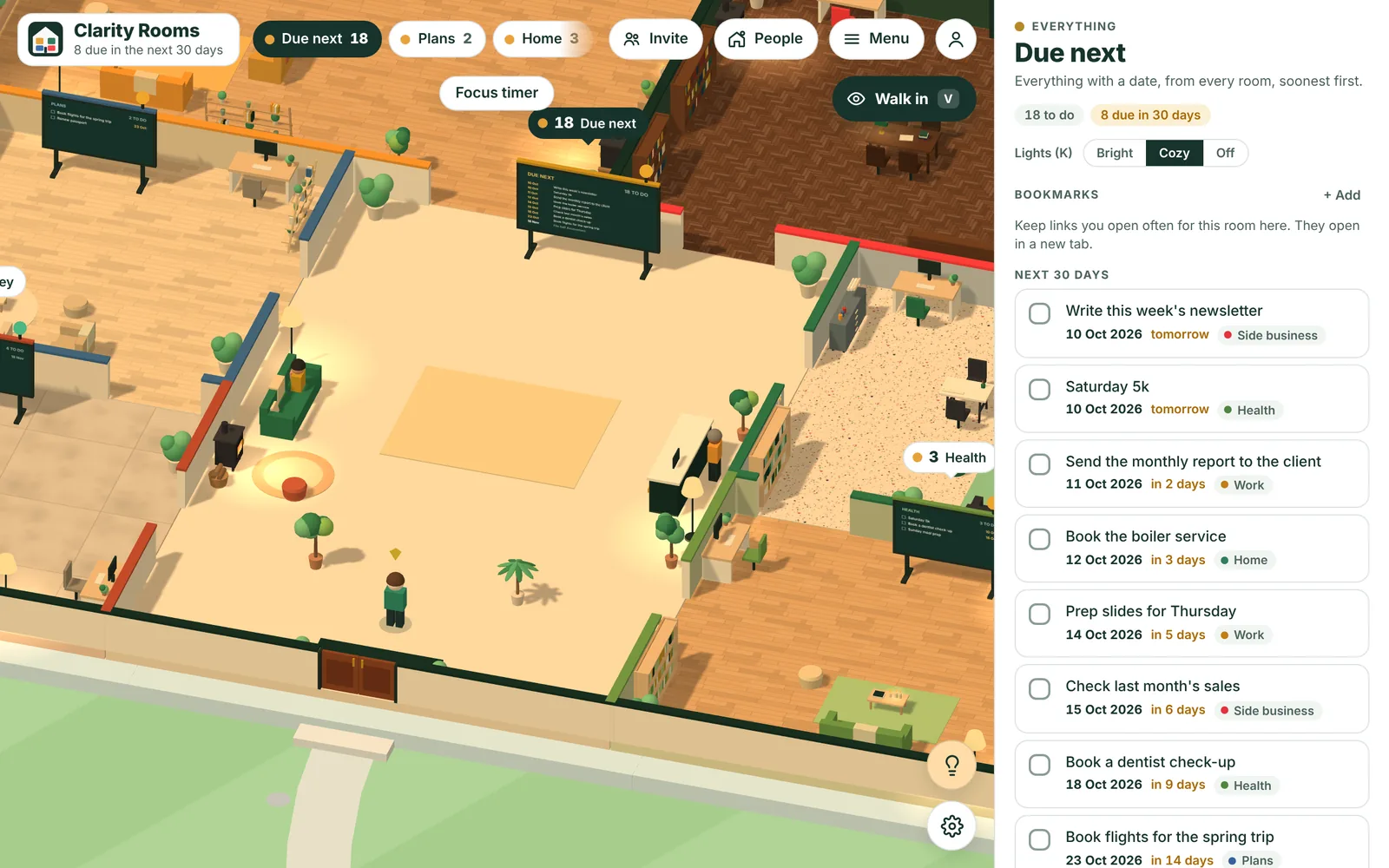
Then I either take the one thing at the top, an eat the frog situation, or pick something a little lower down. Naturally I will drift towards whatever is easiest. That is where I try to trust the system: I know what is coming up, because I put it there.
Step 5: if you keep avoiding a task, break it down
From Jonathan: If I find myself wanting to procrastinate and avoid one particular thing, it is most likely because it needs to be broken down further.
A lot of what makes a task feel heavy is hidden inside it. Before you can even start, you need to find the folder, the spreadsheet, the link, or the login for the account you need. Write those down as the first steps, in order, so the task shows what it really involves.
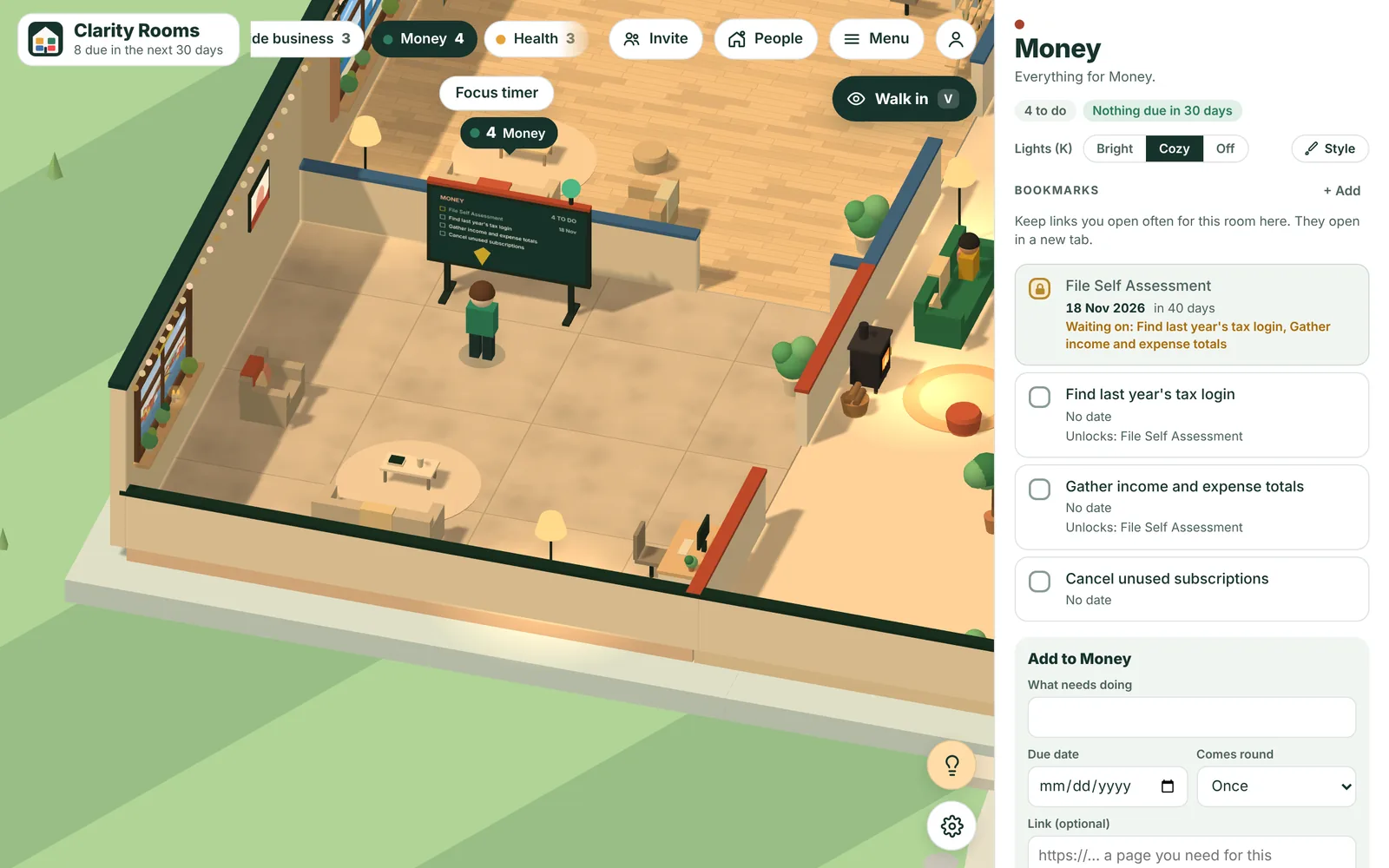
Then chip away at it. There is real motivation in ticking off small steps. For me anyway, I move through the whole thing in a much more deliberate way, instead of circling it for a week.
How I do it now: a spreadsheet with a filter on
I am an accountant by background, so I see things logically, and my first thought is usually a spreadsheet. How would I put this in a spreadsheet?
Picture every single task you need to do as a row. Each one has a category. Home: replace that piece of furniture, clean the house, book the gas engineer. Then work. Then money. Hundreds of rows.
When I want to cut out the noise, I put a filter on. Filter on home, and everything else disappears. Now I can look at just that and ask: what is the next thing to do? When it is done, I take the filter off, go back to the full picture, and filter on something else.
From Jonathan: That is really how Clarity Rooms came about. It is almost like a spreadsheet, but in a 3D space. Walking into a room is putting a filter on just that thing. When you are done, you go back out into the hall and see what is next.
So each area of my life is a room with a board on the wall showing its next steps. From above I can see at a glance which rooms are busy, and the hall in the middle gathers everything with a date. Then I added the things that make me want to sit down with it, like calm background music. I always have something playing on YouTube when I work, so it felt natural to build that in.
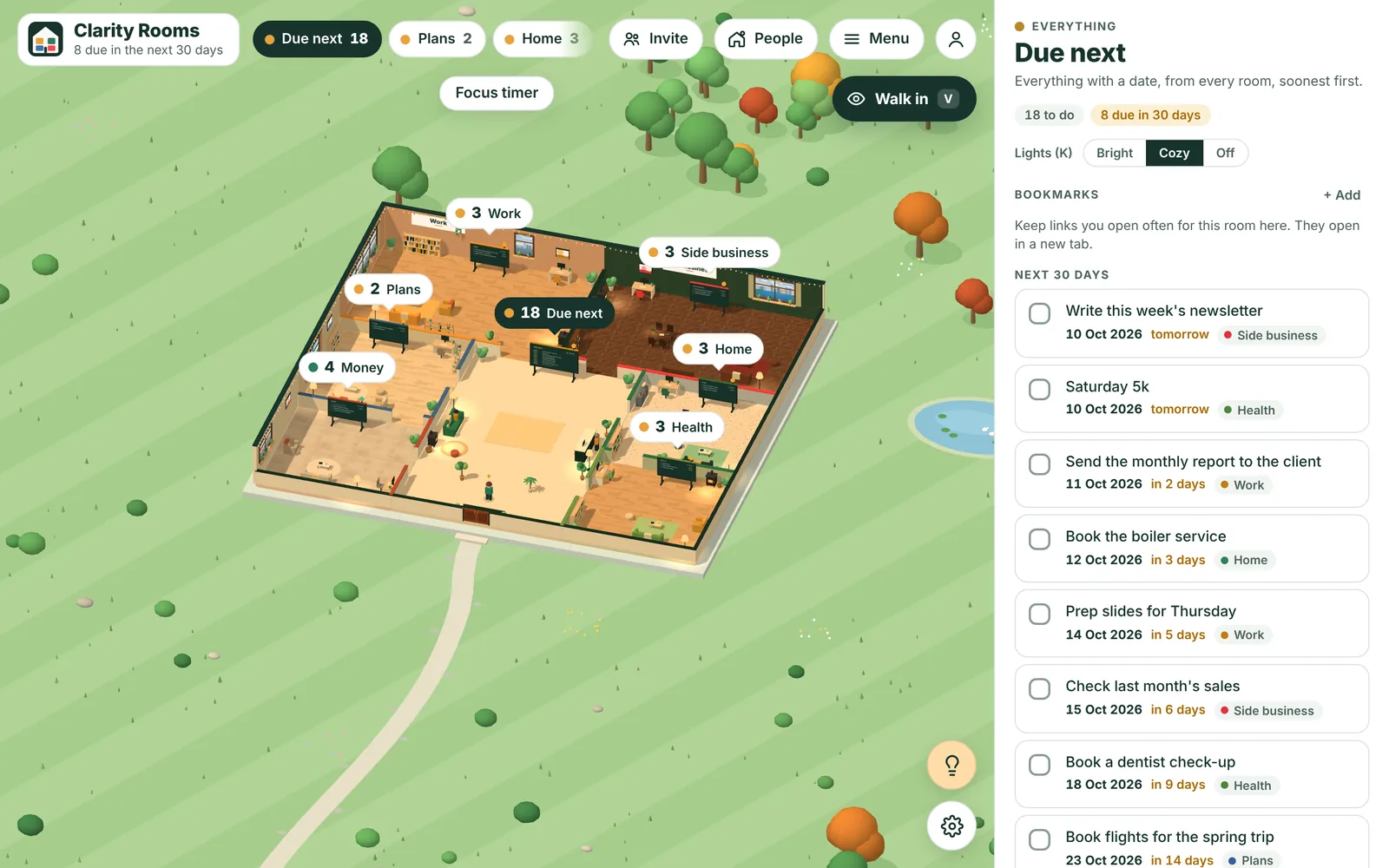
You do not need a house to do this. A notebook with one page per area and a separate page for dates gets you most of the way. What matters is splitting the list so it shows you where your head should be.
This might not suit you if
If you have one job and not much else going on, a single list is probably fine. This helps most when several separate parts of life are all asking for attention at once.
Frequently asked questions
How do I organise my life when I have too much going on?
Split everything into the four to six areas your life really falls into, such as work, a side business, home, money and health. Give each area its own short list of next steps, and keep one separate view of anything with a date. Then each day, look at what is due and focus on one area at a time.
What are the main areas of life to organise?
Most people land on something like work, a side project or business, home, money and health. Use the areas that match your life right now rather than an ideal list, and keep it to six at most so you are not back to one long list with headings.
Why do small tasks always pile up?
Because we prioritise what is urgent and important, small low-importance jobs never win, so they sink to the bottom and quietly build up. Writing down when each one is due and how often it comes round stops them creeping up on you, even if you still choose to do them late.
Why do I keep procrastinating on one particular task?
Usually it is too big or too vague. Break it into smaller steps, starting with the hidden ones like finding the right folder, link or login, then chip away at it one step at a time.
Do I need an app to organise my life this way?
No. A notebook with one page per area and a separate page for dates gets you most of the way. An app like Clarity Rooms makes it more visual: each area is a room, and walking into one is like putting a filter on just that part of your life.